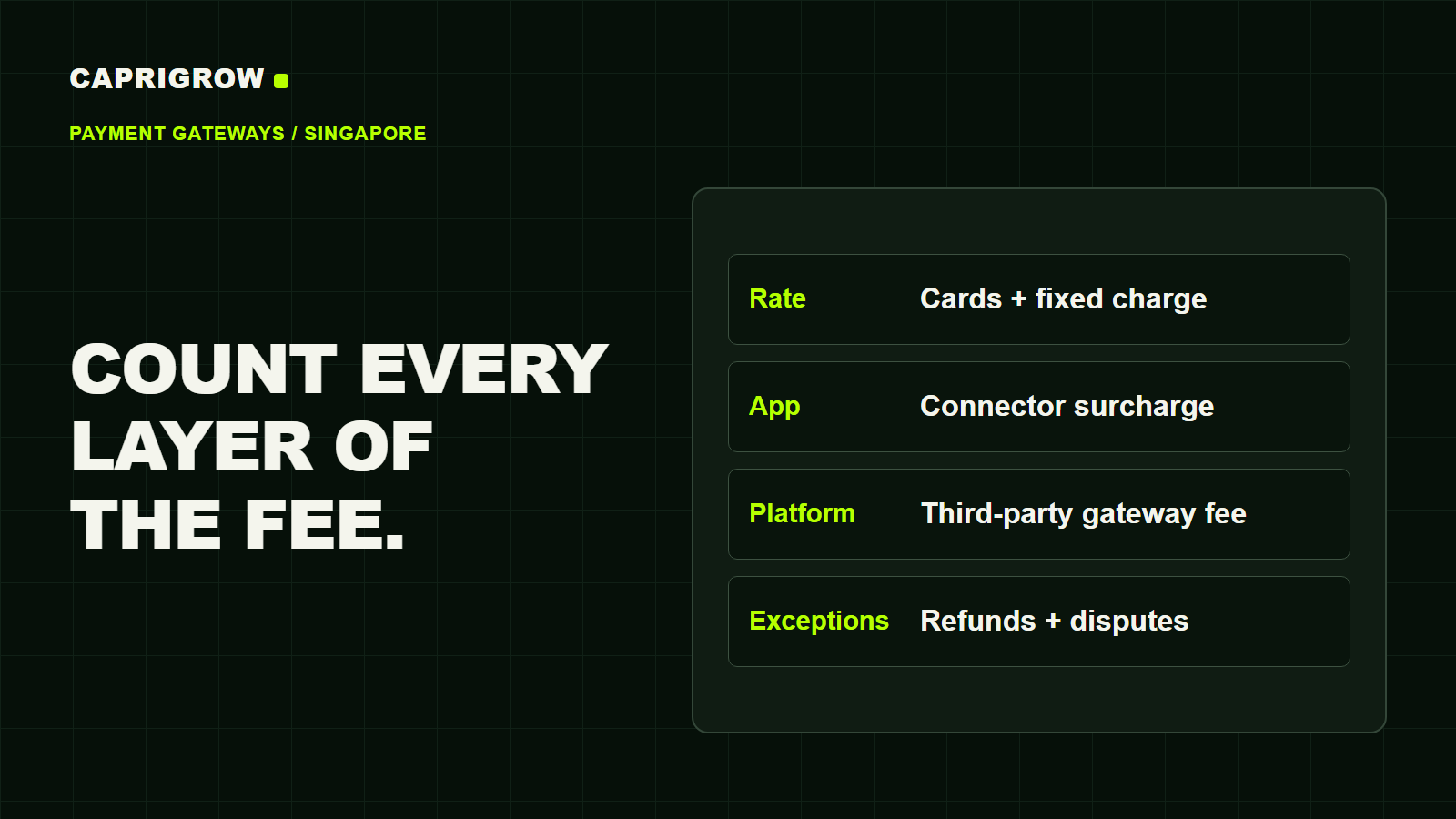
Start with the checkout your business needs to run. A low card rate is useful, but the final bill can also include an integration surcharge, a platform transaction fee and costs when a payment is disputed. Compare the same payment method and store setup before deciding to switch.
This guide compares published Singapore fees and operating differences. It helps you shortlist a suitable setup; it does not promise that the cheapest processing estimate will produce the most profitable store.
Shop Pay and Shopify Payments are different things
Shop Pay is the faster checkout option that lets returning customers reuse their details. Shopify Payments is the underlying payment service. Shopify's Singapore documentation lists Shop Pay, Apple Pay and Google Pay among its accelerated checkouts. Compare the Shopify Payments rate for your plan, rather than looking for a separate universal Shop Pay card rate. 1
Stripe and HitPay can be assessed for websites outside Shopify. Shopify Payments is tied to Shopify. In regions where Shopify Payments is supported, including Singapore, Shopify does not list standalone Stripe as a separate alternative gateway. The three names are therefore not interchangeable installation options on every store. 2
What each paid card order costs you
MDR stands for merchant discount rate: the fee your business pays to accept a card payment. It reduces what you keep from that sale. In this comparison, read the percentage and fixed charge together; app and platform charges are separate layers. 13
The following snapshot was checked on 7 November 2026. It covers published standard online domestic-card processing in Singapore dollars, not international cards, American Express, PayNow or negotiated contracts.
| Provider and setup | Processing fee per paid order (MDR) | On a S$50 order |
|---|---|---|
| Stripe standard | 3.4% + S$0.50 | S$2.20 fee; S$47.80 left |
| HitPay standard, before integration fees | 2.8% + S$0.50 | S$1.90 fee; S$48.10 left |
| Shopify Payments, Basic, sole processor | 3.2% + S$0.50 | S$2.10 fee; S$47.90 left |
The amount left is after the processing fee shown, before product costs, tax and any other charges. For example, Stripe’s percentage charge on S$50 is S$1.70; adding S$0.50 makes the processing fee S$2.20. These estimates exclude platform subscriptions and integration charges. The rates come from Stripe, HitPay and Shopify’s Singapore pricing pages. 3 4 5
To try a different order count and average sale, use the payment-fee calculator in our ecommerce budget guide. The difference is a fee estimate for an assumed pattern, not a forecast of savings after migration.
How platform fees change the result
HitPay publishes an additional 0.5% for its Shopify app. Its other named plugins, including WooCommerce, can add 0.2%. Shopify's own third-party transaction fee is another layer: Basic lists 2%, and other plans have different rates. 6 5
For the same S$50 card order on Shopify Basic, an illustrative HitPay calculation is S$1.40 percentage processing, S$0.50 fixed processing, S$0.25 app surcharge and S$1 Shopify transaction fee: S$3.15 per order. A hundred such orders total S$315. This compares alternative single-card-processor setups; it does not combine two processors' fees on one card payment.
There is also a separate Shopify setup where a direct third-party provider remains the primary card processor while Shopify Payments handles methods such as Shop Pay. Shopify documents a 1.25% premium on the payments it processes in that arrangement. Do not apply that premium to every ordinary Shopify Payments transaction. Check your actual routing and contract before relying on a calculator. 7
Four fee layers on one S$50 order
Illustrative HitPay card payment on Shopify Basic
Processing rate
2.8%S$1.40Fixed processing
Per orderS$0.50HitPay Shopify app
0.5%S$0.25Shopify third-party fee
2%S$1.00Estimated fees per order S$3.15
Illustrative S$50 order on Shopify Basic. Subscription and tax are excluded.
Sources and notes
Choose around the work your business needs
For a custom website, examine the checkout experience and the development work it requires. Stripe offers hosted and embedded checkout interfaces as well as more customisable components. More control can also mean more implementation and testing work; choose it because the business needs that control. 8
For an existing retail or service workflow, check whether HitPay's plugins connect the tools you actually use. Its integration catalogue includes commerce and accounting connections. Confirm the surcharge, supported methods and reconciliation behaviour for the chosen integration rather than assuming every connection costs the same. 6
For a Shopify store, check Shopify Payments first as a platform-integrated route, then identify any missing payment method that justifies another provider. Eligibility and available methods matter as much as the fee. Adding a second service also means checking where refunds, payment records and support requests are handled. 1
Before comparing costs, write down the payment methods your customers will use. Card and PayNow rates are different products. A quote for a domestic card payment should not be compared with a bank-transfer price and described as an equivalent saving.
Choose the checkout around the job
Custom checkout
Review hosted or embedded checkout, integration work and ongoing maintenance.
Connected retail tools
Check the exact plugin, local payment methods and reconciliation workflow.
Shopify checkout
Check the platform-integrated route and any missing method before adding another provider.
Refunds and chargebacks are different
A refund is a return of money that your business initiates. A chargeback starts through the customer's card issuer and becomes a formal dispute. Refunding the customer does not automatically mean the provider returns the original processing fee.
| Provider | What happens to the original processing fee on a refund? | Published dispute-fee points to check |
|---|---|---|
| Stripe | Original processing fees are not returned. Additional terms can depend on the payment method and agreement. | Singapore pricing separates S$15 received, S$15 manually countered and S$15 appealed fees. The countered fee is returned if won; the appealed fee is not. |
| HitPay | Its refund documentation says fees are not refunded. | Singapore chargeback fee: S$20. The documentation says the disputed amount and administrative fee return if the case is resolved in your favour. |
| Shopify Payments | Original card processing fees are not reimbursed; issuing the refund does not add a transaction fee. | Singapore chargeback fee: S$16.35. Its chargeback-process guidance says the fee is returned if you win. |
Sources for this comparison
Sources: Stripe's refund guide and Singapore dispute pricing; HitPay's refund and chargeback guide; Shopify's refund rules and chargeback process. 9 3 10 11 12
Dispute amounts are shown as published; tax treatment can differ. The disputed sale amount is separate from the administrative fee. A S$20 chargeback fee does not cap the exposure on a S$500 disputed sale. Stripe also lists other dispute products and possible network fees; the table is not an exhaustive dispute-cost quotation. 3
For a realistic operational comparison, ask who receives the dispute notice, who gathers delivery or service evidence, and who submits it before the deadline. Keep order confirmations, fulfilment records and customer correspondence easy to retrieve. Fraud tools do not replace that process or guarantee that a dispute will be won.
A refund is not a chargeback
Your business initiates it
- A customer requests a return.
- You issue a supported refund.
- Check which original fees remain.
The card issuer opens a dispute
- The disputed payment is reversed or withheld.
- A dispute fee may be taken.
- Evidence and the outcome affect recovery.
Test the work before moving providers
Use a small checklist with your website team:
- Confirm eligibility, supported methods and the actual fees on the merchant agreement.
- Test a successful payment, a failed payment and the order-confirmation message.
- Process a supported test refund and verify the order and payment records agree.
- Check settlement currency, payout timing, reserves and reconciliation with the provider.
- Find the dispute notification, evidence route and response deadline.
- Check recurring-payment migration and saved-payment limitations before replacing an existing provider.
Record the migration and maintenance cost beside the estimated monthly fee difference. That gives you a business decision rather than a contest between three headline percentages.
For the full opening and running budget, return to ecommerce website costs in Singapore. For launch checks, use our ecommerce payment checklist.
Method and limits: we used the providers' own Singapore pricing and product documentation, checked on 7 November 2026. This is a published-rate comparison with illustrative arithmetic, not a merchant-account audit, negotiated quote or assessment of approval rates. Actual fees can differ with tax, card mix, payment method, contract, integration and per-payment rounding. No affiliate tracking links are used in this guide.
Commercial disclosure: Caprigrow provides website services. This comparison does not establish a universal best provider or promise lower total operating costs. Discuss your checkout requirements.
Sources and references
Sources and references 13 references
- Shopify.Customer payment methods with Shopify Payments in Singapore. Accessed 7 November 2026. Available accelerated checkouts.
- Shopify.Understanding payment gateway availability. Accessed 7 November 2026. Standalone Stripe in Shopify Payments regions.
- Stripe.Singapore pricing and fees. Accessed 7 November 2026. Standard domestic-card and dispute fees; additional terms.
- HitPay.Singapore pricing. Accessed 7 November 2026. Standard domestic online card rate.
- Shopify.Singapore pricing. Accessed 7 November 2026. Basic card and third-party transaction rates.
- HitPay.Payment plugins for Shopify, WooCommerce, Wix and Xero. Accessed 7 November 2026. Integration scope and surcharges.
- Shopify.Using Shopify Payments with a third-party provider. Accessed 7 November 2026. Conditional premium and routing.
- Stripe.Build a payments page. Accessed 7 November 2026. Hosted, embedded and customised checkout options.
- Stripe.Refund and cancel payments. Accessed 7 November 2026. Retained processing fees.
- HitPay.Refunds and Chargebacks. Accessed 7 November 2026. Singapore dispute fee and refund terms.
- Shopify.Shopify Payments refunds. Accessed 7 November 2026. Refund and retained card-fee rules.
- Shopify.Responding to chargebacks and inquiries. Accessed 7 November 2026. Singapore fee and chargeback process.
- Stripe.Credit card processing fees explained. Accessed 7 November 2026. Meaning of merchant discount rate.
Plan your next step.
Check an existing website or talk to Caprigrow about the work you need.