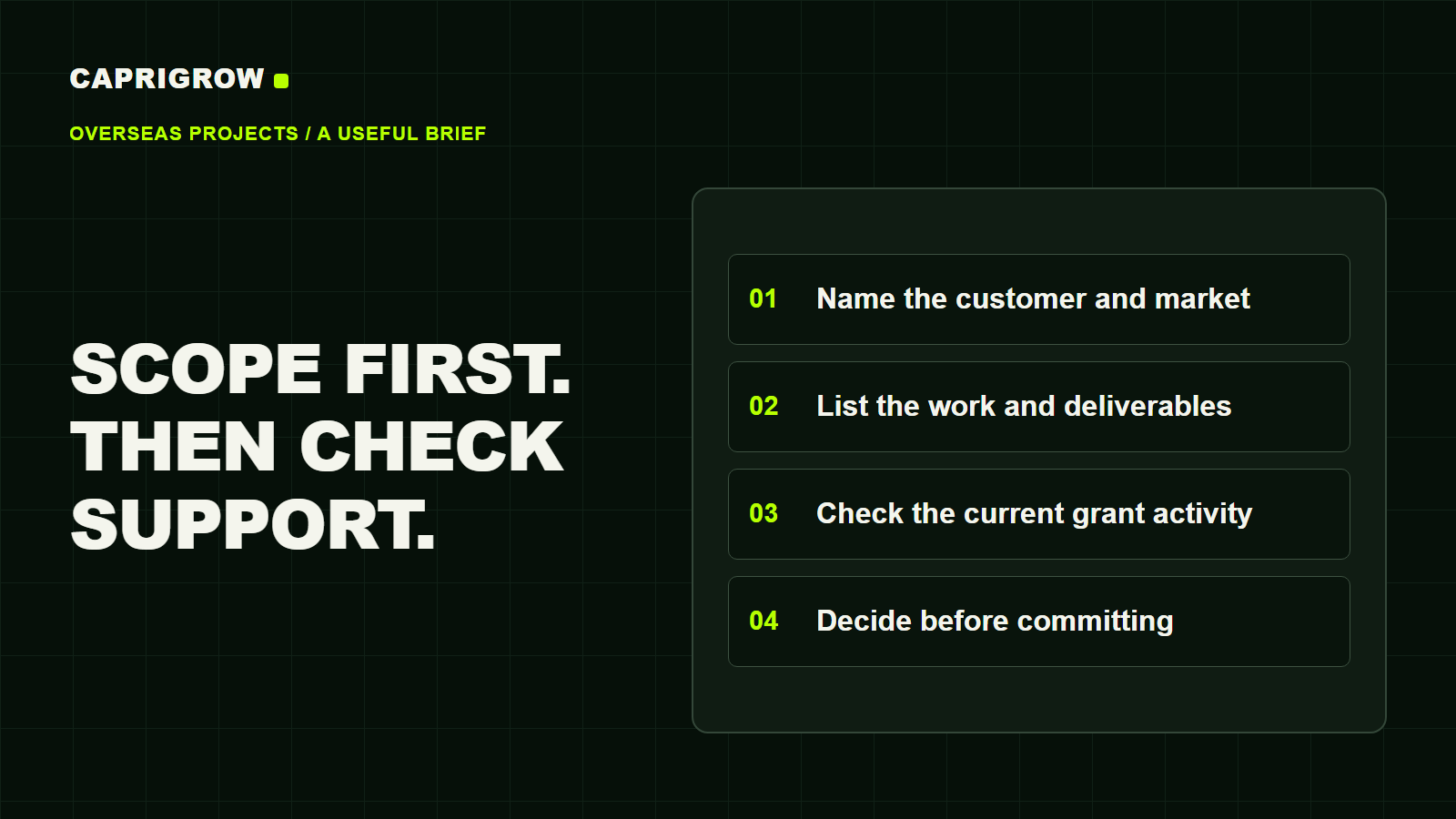
If you are preparing a website for customers overseas, settle the project scope before relying on a grant to pay for it. A translated catalogue, an international checkout and a market-entry campaign are different pieces of work. They need separate deliverables and a check against the current support rules.
Can you still apply for MRA?
Enterprise Singapore, the government agency responsible for enterprise development, states that MRA, EDG and PSG ceased on 29 September 2026. New applications move to EDGE from 30 September. Existing submissions and ongoing projects continue under their respective schemes. An old MRA article or vendor brochure is therefore not a reliable guide for a new application. 1
For a new website project, start with the current EDGE activity that fits the business outcome. Do not assume that calling a proposal “overseas marketing” makes every website expense eligible.
A new project and an existing award take different routes
29 September 2026
Last day of MRA, EDG and PSG
Earlier submissions and ongoing awards continue under their respective schemes.
From 30 September 2026
New applications use EDGE
Check the current activity that fits your proposed business outcome.
New applications and existing awards follow different routes. Eligibility depends on the selected activity.
Sources and notes
What must you check before committing?
Enterprise Singapore's EDGE guidance makes support dependent on the selected activity. Its published maximum support level is not a promised discount on your website quote. Support is reimbursed after completion and full payment, subject to the applicable requirements. 2
The EDGE FAQ also says that starting work or paying a supplier, including a deposit, before submitting the application makes it retrospective and unsupported. Committing after submission but before approval remains at your risk: submission does not guarantee funding. Vendor requirements differ by activity. 3
Before signing or paying, ask which activity applies, which costs it supports and what timing restrictions govern the project. Keep the answer with the proposal rather than relying on a sales conversation.
Write the business outcome before the feature list
“We want an overseas website” leaves too many decisions open. A more useful brief explains who needs the site and what they should be able to do there.
For example: “A buyer in our intended market should be able to understand the range, check delivery availability and request a wholesale quotation.” That gives a supplier something to design and test. It does not claim grant eligibility or promise overseas sales.
Use four short headings to prepare the brief:
| Brief heading | What to record |
|---|---|
| Customer and market | Who will use the website, where they are and which language they need. |
| Customer action | Whether they should buy, enquire, book or request a trade account. |
| Existing obstacle | What the current website prevents them from understanding or completing. |
| Completion evidence | What you will inspect or test before accepting the work. |
A supplier should be able to explain how each proposed feature helps with that outcome. If the connection is unclear, ask for a simpler scope or a separate optional price.
Turn “an overseas website” into a usable brief
Illustrative example · a Singapore homeware business
Who should the website help?
An overseas wholesale buyer who needs to understand the range and request a quotation.
Name the market, the customer and their next action.
What exactly will be delivered?
Agreed product pages, delivery information and a trade-enquiry form, with product counts and languages stated.
Ask for a deliverable, price and responsible person beside each item.
How will you know it works?
Approved product text is visible; delivery information is easy to find; a test enquiry reaches the agreed inbox.
Write an acceptance check before agreeing to the build.
Split the proposal into inspectable pieces
Here is an illustrative project brief for an invented Singapore homeware business exploring a second market. It is a scoping example, not a funded project or an eligibility assessment.
| Proposed work | Deliverable to request | Acceptance check |
|---|---|---|
| Localised product information | Named pages, language and product count | Approved text appears on the agreed pages and products. |
| Delivery information | Delivery destinations and stated exclusions | A customer can check availability before placing an order. |
| Trade enquiry route | Form fields and agreed receiving address | A test enquiry reaches the correct person with its details intact. |
| Measurement setup | Named customer actions to record | A test action appears in the agreed measurement tool. |
| Staff handover | Editing instructions and access list | The owner can update a product and locate an enquiry. |
Ask for the price, responsible person and delivery date beside each item. Keep optional advertising, ongoing subscriptions and future phases visible as separate lines. This makes the commercial proposal easier to assess even if you decide to proceed without funding.
Prepare questions for the grant adviser
Take the brief and itemised proposal to the appropriate official contact. Ask:
- Which current activity, if any, fits this project?
- Which proposed lines are supportable, excluded or still unclear?
- Are there specific vendor qualifications or pre-approved packages?
- What evidence is needed before application and at completion?
- What dates must the business observe before work or payment begins?
Enterprise Singapore's FAQ points businesses with an uncertain project scope to its activity information, BizSG or an SME Centre. It also states that the applicant company must apply, pay and claim through its authorised personnel; a vendor must not submit on the company's behalf. 3
The outcome of this preparation should be a clear project and a documented funding decision. Keep a separate budget for proceeding without support. If the project only works financially with an unconfirmed grant, resolve that uncertainty before committing to the supplier.
For the wider funding landscape, read our Singapore SME grants guide. For help preparing a comparable supplier brief, read our website quote preparation guide.
Scope and method: this guide uses Enterprise Singapore's programme pages and FAQ, checked on 6 November 2026. It explains the transition and provides an original project-scoping worksheet. It does not determine your company's eligibility or establish that a website, advertising expense or particular supplier is supported. Check the selected activity's current requirements before committing.
Commercial disclosure: Caprigrow provides website services. This guide does not claim that Caprigrow is a pre-approved grant vendor or that its services qualify for funding. Discuss the website scope; eligibility remains a separate decision.
Resolve the funding question before you commit
- 01
Define the outcome
Name the customer and the action the site should support.
- 02
Itemise the proposal
Separate deliverables, costs and optional work.
- 03
Check the activity rules
Confirm eligibility, vendor requirements and permitted timing.
- 04
Decide before starting
Submission is not approval. Do not assume a deposit is supportable.
Check the activity and timing rules before starting work or paying a deposit.
Sources and notes
Sources and references
Sources and references 3 references
- Enterprise Singapore.Market Readiness Assistance Grant. Accessed 6 November 2026. Scheme closure, transition and treatment of ongoing projects.
- Enterprise Singapore.EDGE Grant. Accessed 6 November 2026. Activity-dependent support and reimbursement.
- Enterprise Singapore.FAQ: EDGE Grant. Accessed 6 November 2026. Retrospective applications, timing risk, vendor requirements, guidance routes and applicant responsibility.
Plan your next step.
Check an existing website or talk to Caprigrow about the work you need.