Local SEO is the work of helping a search engine and a customer reach the same conclusion: this is a real business, it offers the service I need, it serves my area and I can trust the next step.
Start with the decision, not the ranking
Fix the business facts first. Then build one genuinely useful page for every important service, collect honest customer proof and measure calls, bookings or enquiries. A ranking screenshot is not the business result.
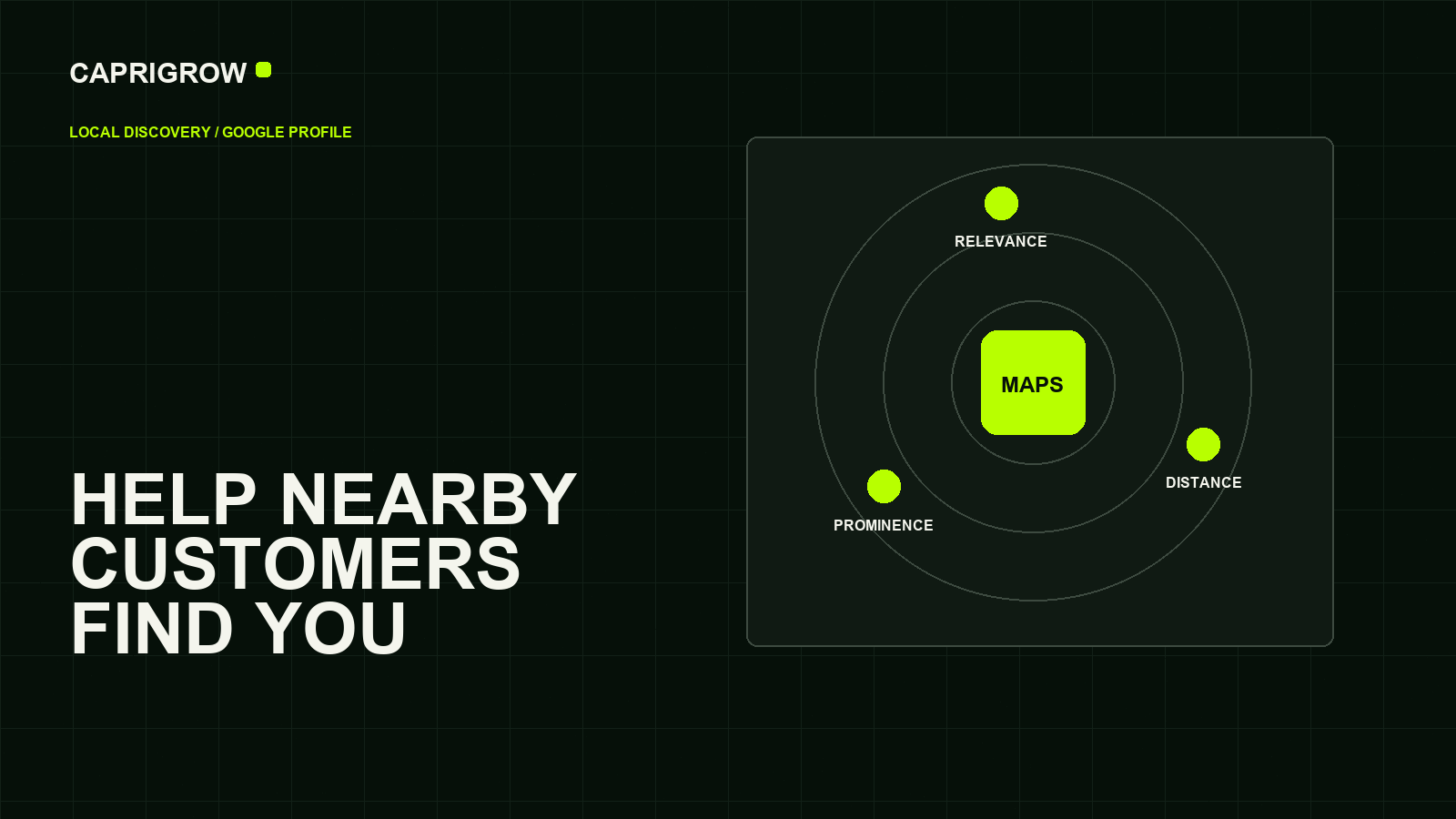
Three factors, but only two are meaningfully influenceable
How closely the profile and website match what the person is trying to find.
Improve the informationHow far the business is from the searched place or the searcher's inferred location.
Mostly fixedHow established the business appears through reviews, links, mentions and other signals.
Build over timeGoogle says local results are mainly based on relevance, distance and prominence, and that businesses cannot request or pay for a better organic local ranking.[1] That changes the sensible goal. The goal is not to “rank number one in Singapore” for every broad phrase; it is to become a strong, accurate answer for the services and areas the business truly serves.
Build a baseline before changing anything
Record what currently happens so progress can be judged against something real. Search for the business name, two or three important services and the neighbourhoods that matter. Do this as a customer would, but do not treat one device's result as a universal ranking: location, language, device and search history can change what appears.
Create a small baseline with four groups of evidence:
- Business factsName, category, phone, hours, address or service area.
- Customer pathsCall, directions, booking, WhatsApp, form or purchase.
- Search evidenceQueries, impressions, clicks and indexed pages.
- ReputationReview count, recency, themes and owner responses.
- Page qualityService detail, proof, mobile use and clear next action.
- OutcomeQualified enquiries, appointments, visits or sales.
Google Search Console's performance report shows search queries, pages, countries, devices, impressions and clicks.[2] Google Business Profile performance can show interactions such as calls, website clicks and direction requests when available.[3] Neither tells the whole story, so connect those signals to the business's own enquiry or booking records.
Fix the profile customers see first
Use the real-world business name. Pick the most specific primary category that describes the main business, then add only relevant secondary categories. Enter a phone number the team answers, accurate opening hours, the correct website page and a truthful address or service area.
Google's representation guidelines require businesses to reflect their real-world identity and use as few categories as needed to describe the core activity.[4] Adding extra service words to the business name may look tempting, but it can make the listing inaccurate and create avoidable suspension or trust problems.
- Claim and verify the correct profile
- Remove duplicate profiles or resolve them through official support
- Use the real business name and most accurate primary category
- Keep regular, holiday and temporary hours current
- Link to the most relevant page, not automatically the home page
- Add actual services, helpful attributes and clear recent photographs
- Give staff individual access instead of sharing a personal password
A mobile service or home-based business should follow Google's address and service-area rules. Do not display an address where customers are not actually served merely to create another map location.
Build pages around customer decisions
A local service page should answer six questions quickly: What is the service? Who is it for? Where is it available? What happens next? What does it cost or what changes the price? Why should the customer trust this business?
One complete dental implant page, for example, is more useful than twenty suburb pages that repeat the same paragraph with a different place name. Google's people-first content guidance asks whether content is made for an existing audience, demonstrates first-hand expertise and leaves the reader feeling they learned enough to achieve their goal.[5]
Use descriptive page titles and headings. Put the business name, contact details and service area where people can find them. Link related services naturally. Add Organization or LocalBusiness structured data only when it accurately represents visible page information; Google says structured data can help it understand a page but does not guarantee a special search appearance.[6]
Name the service and customer problem in ordinary language.
Explain what happens before, during and after the service.
Show real work, credentials, policies, areas served and customer proof.
Make calling, booking or asking a question easy on a phone.
Earn reviews and mentions without manufacturing them
Ask customers for an honest review after a genuine interaction. Make the review link easy to reach, but do not offer a reward only for a positive rating, write reviews for customers or pressure them to remove criticism. Google's policies prohibit fake engagement and content posted because of incentives when the incentive influences the content.[7]
Respond briefly and professionally. A useful reply acknowledges the experience and, where needed, moves personal details into a private channel. Reviews should not become a place to publish health, financial or other sensitive information.
Prominence is wider than review count. Accurate listings with established associations, suppliers, industry bodies and relevant directories can help people verify a business. Prioritise sources customers actually use; hundreds of low-quality directory entries are not a substitute for a credible business.
A practical 90-day plan
| Timing | Work | Evidence of completion |
|---|---|---|
| Days 1-15 | Fix profile ownership, categories, hours, contact details, duplicates and tracking. | Verified profile; baseline recorded; customer actions tested. |
| Days 16-30 | Rewrite the most important service page and add missing proof. | One complete page that answers the customer's decision. |
| Days 31-60 | Publish the next priority service or location page and begin a steady review request process. | Useful new page; honest review requests sent after real work. |
| Days 61-90 | Review Search Console, profile interactions and qualified enquiries; fix the weakest path. | Before-and-after record with one next improvement selected. |
Do not change everything at once. A smaller sequence makes it possible to learn whether the issue was missing information, a weak page, low trust or a broken customer journey.
Measure the business result, not just visibility
A useful monthly report can fit on one page. Record non-brand searches that match real services, profile calls or direction requests, website enquiries, appointment quality and completed sales where the business can track them responsibly. Add notes for seasonal closures, campaigns and large site changes.
Look for patterns over several months. More impressions with no enquiries may mean the page appears for the wrong need. More calls with many unsuitable prospects may mean the service area or offer is unclear. Fewer clicks with more booked appointments may still be an improvement.
Fix the business facts this week. Improve one service page this month. Ask for honest feedback after real work. Review qualified outcomes after 90 days.
References and method
Caprigrow reviewed official Google documentation on 8 September 2026 and translated it into an owner workflow. Google does not disclose a complete local ranking formula, so no percentages or ranking guarantees are presented.
- Google Business Profile Help: Tips to improve your local ranking. Local factors and profile completeness. ←
- Google Search Console Help: Performance report. Search measurement. ←
- Google Business Profile Help: Check and view Business Profile performance. Profile interactions. ←
- Google Business Profile Help: Guidelines for representing your business. Names, categories and service-area rules. ←
- Google Search Central: Creating helpful, reliable, people-first content. Page usefulness. ←
- Google Search Central: Local business structured data. Machine-readable business information. ←
- Google Maps User Contributed Content Policy: Fake engagement. Review integrity. ←