The CTC Grant is not simply “for larger SMEs,” and EDG is not simply “for smaller ones.” Start with what changes, who benefits, what evidence the project will produce and which agency contract matches that work.
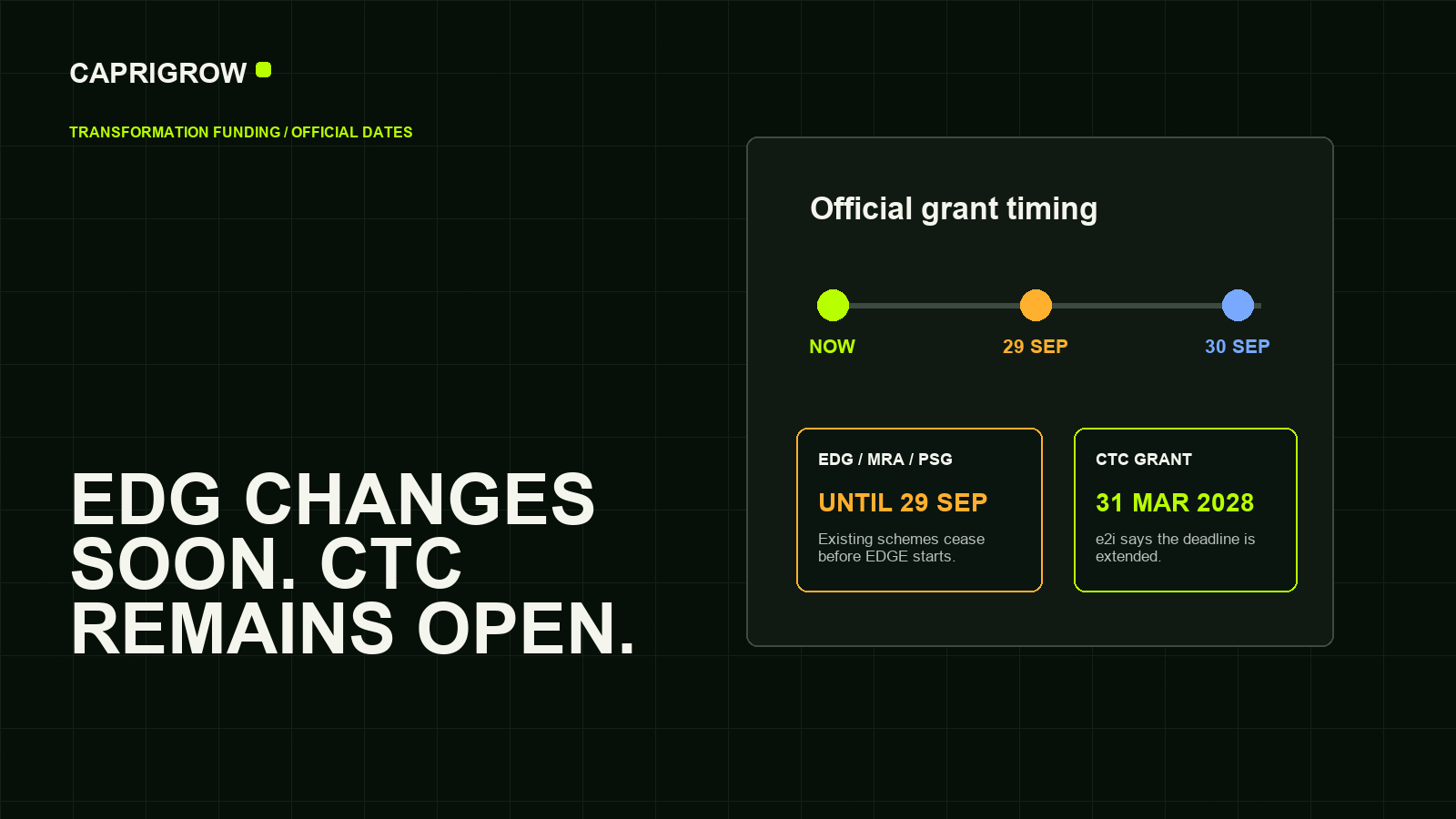
Enterprise Singapore now states that EDG, MRA and PSG will cease on 29 September 2026, with EDGE Grant applications replacing them from 30 September 2026.[1] NTUC's e2i currently states that the CTC Grant deadline has been extended to 31 March 2028, although the FAQ section still shows the earlier 1 August 2022 to 31 July 2026 application window.[2] Check the live programme page before signing, paying or beginning work.
Choose by the promise the project makes
EDG supports a tailored project to strengthen business capabilities, improve productivity and innovation, or enter markets. CTC Grant supports transformation backed by a Company Training Committee and requires business outcomes plus concrete worker outcomes.
Similar cost items can sit inside very different cases
A tailored proposal under Core Capabilities, Innovation & Productivity or Market Access.
A CTC-endorsed transformation plan with training, wage, skills allowance or career-development outcomes.
| Question | EDG | CTC Grant | What it means |
|---|---|---|---|
| Who administers it? | Enterprise Singapore | NTUC's Employment and Employability Institute, e2i | Use the correct official adviser and portal. |
| Published support | Up to 50% of eligible costs for local SMEs; selected sustainability work may have different support | Up to 70% of qualifying costs | The rate is a ceiling, not a quote or approval. |
| Core structure | Individual project proposal and measurable business outcomes | CTC first, then an endorsed transformation plan | CTC Grant needs worker representation built into the project. |
| Possible cost types | Third-party consultancy, software/equipment, incremental internal manpower | Training tied to transformation, equipment/software and consultancy | Cost labels overlap, but programme logic differs. |
| Worker requirement | Application documents include projected worker impact | At least one defined worker outcome is required | CTC worker outcomes are central, not an afterthought. |
| Start rule | New project; no work, payment or relevant contract before application | Engage e2i and follow the approved project sequence | Do not let procurement run ahead of eligibility. |
How the Enterprise Development Grant works
Enterprise Singapore describes EDG as support for projects that help companies upgrade, innovate, grow and transform. It can fund qualifying third-party consultancy, software and equipment, and incremental internal manpower costs. Current published support is up to 50% of eligible costs for local SMEs, with different support possible for specified sustainability-related projects.[1]
Published eligibility includes registration and operation in Singapore, at least 30% local equity and financial readiness to start and complete the project. Enterprise Singapore assesses the scope, outcomes and service-provider competency.
Three project categories
- Core Capabilities: work such as business strategy, financial management, human capital, service excellence and strategic brand development.
- Innovation & Productivity: automation, process redesign, product development and related capability building.
- Market Access: eligible projects that build the company's route into new markets.
EDG is not a general marketing-production subsidy. The official strategic brand and marketing section excludes production of websites, photography, videos, advertising, SEO, SEM and ongoing campaign management from that category.[1] A business should not assume a new website is funded merely because it appears inside a broader growth plan.
Application sequence
There are no pre-approved EDG vendors. Management consultancy costs generally require a consultant with the specified Singapore Accreditation Council-accredited TR 43 or SS 680 certification, subject to official exceptions for roles such as technical specialists.[1]
The business applies directly through the Business Grants Portal using Corppass. The project must be new: Enterprise Singapore treats work started, payments made or relevant third-party contracts signed before the application date as commencement. A complete application currently takes about 8 to 12 weeks to process.
How the NTUC CTC Grant works
A Company Training Committee, or CTC, brings company management together with NTUC and worker representatives to develop a transformation plan. The CTC Grant then supports qualifying implementation that improves business performance and worker outcomes. e2i publishes support of up to 70% of qualifying costs per project.[2]
Singapore-registered entities may apply, subject to published exclusions for government bodies, statutory boards, organs of state and wholly-owned government subsidiaries. The transformation plan must be endorsed by the CTC's NTUC or worker representative.
The project needs both sides of the result
Examples can include productivity, processes, service quality, innovation or new capability, supported by measurable targets.
At least one required route: wage increase, a recurrent skills allowance, a one-time allowance for relevant training, or a communicated Career Development Plan.
The grant can support training linked to the transformation, equipment or software, and consultancy. It is not simply a cheaper way to buy a system. The plan must explain how the technology, redesigned work and worker outcomes connect.
e2i advises companies to engage it before submitting a project. A business that has not formed a CTC should begin with the CTC enquiry channel, not a supplier invoice.
Three scenarios show the difference
Scenario 1: replace an off-the-shelf accounting tool
If the need is a listed, pre-approved productivity solution with limited custom work, PSG or its successor route may be the more proportionate first check. Building a full EDG or CTC transformation case around a routine replacement can add complexity without improving fit.
Scenario 2: integrate operations and redesign jobs
A distributor wants to connect inventory, ordering and fulfilment, redesign warehouse roles, train staff and introduce a career pathway for team leads. The worker-linked transformation makes the CTC Grant worth discussing with e2i, provided the CTC and endorsed plan requirements can be met.
Scenario 3: build a strategic capability
A manufacturer needs a formal process-redesign project, a new measurement system and sophisticated automation across several operations. EDG's Innovation & Productivity route may fit the business capability case, subject to official assessment and the exact project scope.
If more than one programme appears relevant, show the full project and every intended funding source to the administering bodies. Ask them how to separate costs and outcomes before applying. Do not assume the same invoice can be claimed twice.
Model the full cash requirement
Start with the supplier's full price, then separate costs that appear eligible from costs that are clearly outside the scheme or still uncertain. Apply the support ceiling only to the eligible assumption, and keep a contingency for items the assessment or claim does not accept.
In this EDG-style illustration, the business still carries S$110,000 of the S$180,000 project. It may also need enough cash to complete the work before reimbursement. The figures explain the method; they do not predict an award.
Enterprise Singapore says EDG claims are reimbursement-based and submitted after project deliverables are achieved. Claims must arrive within the period set by the Letter of Offer, generally no later than six months from the end of the qualifying period.[1]
Prepare a case that can be assessed
- BaselineCurrent process, cost, time, errors, capacity and worker roles.
- ProblemWhy the constraint matters now and who experiences it.
- InterventionConsultancy, process, technology, training and implementation work.
- OutcomeMeasurable business result, not only “system installed”.
- PeopleJobs affected, skills needed and concrete worker benefits.
- EvidenceQuotes, milestones, acceptance tests and post-project measures.
For EDG, prepare the relevant project proposal, financial information, ACRA documents, quotations and outcome projections listed on the official page. For CTC Grant, begin with the CTC and an endorsed transformation plan, then develop the project with e2i.
Do not let a vendor write the business case in isolation. The company must be able to explain the operational problem, own the target and continue the change after the supplier leaves.
Official hotlines and help channels
| Need | Official channel | Use it for |
|---|---|---|
| EDG programme question | Enterprise Singapore: +65 6898 1800, Mon-Fri 8:30am-5:30pm | Project-category, eligibility and programme questions. |
| EDG portal problem | Business Grants Portal Helpdesk: +65 6708 7288, Mon-Fri 8:30am-5:30pm | Technical help with the application portal. |
| Form a CTC | CTC enquiry form or trainandtransform@ntuc.org.sg | Start the Company Training Committee conversation. |
| Discuss a CTC Grant project | CTC Grant project enquiry | Project fit and preparation before submission. |
| General e2i assistance | e2i enquiry form or +65 6474 0606 | Route a CTC Grant question to the appropriate team. |
Official help is most useful before procurement. Bring a one-page project summary, rough budget, desired timing, current baseline and expected business and worker outcomes.
References and method
Caprigrow compared official programme and contact pages on 15 September 2026. Scheme rules and transition dates can change. The official programme, portal and Letter of Offer take precedence.
- Enterprise Singapore: Enterprise Development Grant. Purpose, categories, eligibility, costs, timing, application, claims and the 29 September 2026 transition to EDGE. ←
- NTUC's Employment and Employability Institute: NTUC CTC Grant. Support, outcomes, eligibility, extended 31 March 2028 deadline and earlier FAQ application window. ←
- Enterprise Singapore: EDGE Grant. Replacement grant beginning 30 September 2026.
- National Trades Union Congress: Company Training Committee Grant. Programme overview and CTC context.
- Enterprise Singapore: EDG frequently asked questions. Project and application detail.
- Enterprise Singapore: Contact us. Enterprise Infoline and operating hours.
- e2i: NTUC CTC Grant enquiry. Official enquiry form and hotline.
- Business Grants Portal: Who we are. Official application portal context.